
Compression Ratio Calculator
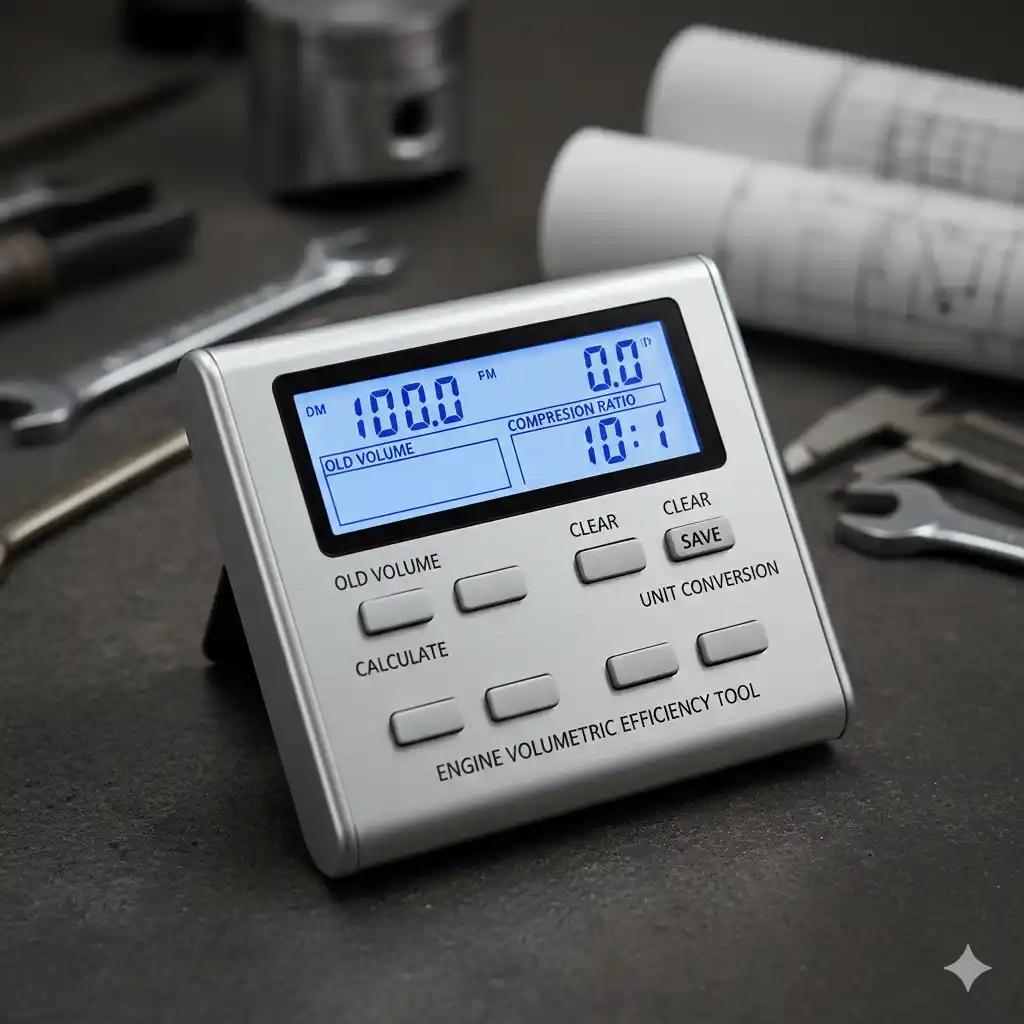
Complete Guide to Compression Ratio Calculator: How It Works and Why It Matters
If you’re building an engine or tuning your car, understanding your compression ratio is crucial. That’s where a reliable compression ratio calculator becomes your best friend. This comprehensive guide will show you exactly how our compression ratio calculator works and why it’s essential for any engine project.
What is a Compression Ratio Calculator?
A compression ratio calculator is a specialized tool that helps you determine how much your engine compresses the air-fuel mixture before ignition. Think of it like this: when your piston moves up in the cylinder, it squeezes the mixture. The compression ratio tells you how much squeezing is happening.
Our online compression calculator takes the guesswork out of engine building. Whether you’re working on a small Honda engine or a powerful LS motor, this engine compression ratio calculator gives you accurate results in seconds.
Why Use Our?
Accuracy You Can Trust
Unlike many simple tools online, our professional compression calculator includes all the critical measurements. While basic calculators might give you rough estimates, our tool delivers precise calculations that professional engine builders rely on.
Easy to Use
Our calculator is designed with simplicity in mind. You don’t need to be an engineering expert to get accurate results. Just enter your engine specifications, and let the calculator compression ratio tool do the heavy lifting.
Complete Results
When you use our ratio calculation tool, you get more than just a number. You’ll see:
- Your exact compression ratio
- Total engine displacement
- Detailed volume breakdown
- Practical interpretation of what your ratio means
How the Compression Ratio Calculator Works
The Basic Formula
Every compression calculator uses this fundamental formula:
Compression Ratio = (Swept Volume + Clearance Volume) ÷ Clearance Volume
Let’s break this down in simple terms:
Swept Volume: This is the space the piston moves through from bottom to top
Clearance Volume: This is all the space remaining when the piston is at its highest point
Understanding the Key Measurements
When you’re ready to calculate compression ratio, you’ll need these measurements:
Cylinder Bore
- This is the diameter of your engine cylinders
- Measured in inches or millimeters
- Larger bore = more displacement
Stroke Length
- How far the piston travels up and down
- Longer stroke = more torque
Combustion Chamber Volume
- The space in your cylinder head
- Measured in cubic centimeters (cc)
- Smaller chambers = higher compression
Piston Volume
- Dome pistons (negative numbers) increase compression
- Dish pistons (positive numbers) decrease compression
- Flat-top pistons = zero
Head Gasket Details
- Thickness affects how much space the gasket takes
- Bore diameter must be accurate for precise calculations
Deck Clearance
- Positive: piston below deck surface
- Negative: piston above deck surface
- Zero: piston flush with deck
Step-by-Step: How to Calculate Compression Ratio
Using our calculator is straightforward:
- Select Your Units – Choose between imperial or metric measurements
- Enter Basic Engine Specs – Bore, stroke, and chamber volume
- Add Advanced Details – Piston type, gasket specs, deck clearance
- Click Calculate – Get instant, accurate results
- Review Your Results – Understand what your ratio means for performance
Real-World Applications
For Street Performance
When building a street engine, our calculator helps you find the sweet spot between power and reliability. Most street engines work best between 9:1 and 11:1 compression ratios.
For Race Engines
Race engines often push compression ratios to 13:1 or higher. Our dynamic features help you optimize for maximum power while avoiding engine damage.
For Forced Induction
If you’re adding a turbo or supercharger, our effective capabilities are essential. Lower compression ratios (8:1 to 9:1) work better with forced induction.
Ranges
| Engine Type | Typical CR Range | Fuel Requirement |
|---|---|---|
| Stock Street | 8:1 – 10:1 | Regular Unleaded |
| Performance Street | 10:1 – 11:1 | Premium Unleaded |
| Race Engine | 12:1 – 14:1 | Race Fuel |
| Turbo/Supercharged | 8:1 – 9:1 | Premium Unleaded |
Why Our Compression Ratio Calculator Stands Out
Complete Measurement Support
Unlike many online compression ratio calculator tools, ours includes gasket bore diameter – a critical measurement that most calculators ignore. This ensures professional-level accuracy for serious engine builders.
Mobile-Friendly Design
Our calculator works perfectly on phones, tablets, and computers. Whether you’re in the garage or at the track, you can calculate engine compression ratio anywhere.
Educational Value
We don’t just give you a number – we help you understand what it means. Our compression calculation tool explains your results in plain English.
Frequently Asked Questions
How accurate is this compression ratio calculator?
Our calculator uses the same mathematical formulas that professional engine builders use. It includes all critical measurements like gasket bore diameter, which many online calculators skip. For most applications, it’s easily accurate within 1-2%.
Can I use this calculator for any engine type?
Yes! Our engine compression ratio calculator works for:
- Car and truck engines (LS, SBC, Honda, etc.)
- Motorcycle engines
- Small engines
- Diesel engines (with appropriate fuel considerations)
What's the difference between static and dynamic compression ratio?
Static compression ratio is what our main compression calculator determines – it’s based purely on physical engine dimensions. Dynamic compression ratio accounts for when the intake valve closes, which affects actual compression. We’re developing a dynamic compression calculator add-on for advanced users.
How do I measure combustion chamber volume?
You’ll need to physically measure this using a burette and plexiglass. Most machine shops can do this for you, or you can buy a CC measuring kit online. Accurate chamber volume is crucial for precise compression calculation.
Can I estimate compression ratio from PSI readings?
While you can get rough estimates, our PSI to compression calculator feature (in development) will provide more accurate conversions. For now, we recommend using physical measurements with our main compression ratio calculator for best results.
Is this better than Summit's compression ratio calculator?
Our compression calculator includes several advanced features that many others lack, particularly the gasket bore measurement. While Summit’s calculator summit is good, ours provides professional-level accuracy that serious engine builders appreciate.
Start Using Our Tools Today
Whether you’re a seasoned engine builder or just starting your first project, our calculator takes the confusion out of compression math. Get accurate results, understand what they mean, and build with confidence.
Ready to calculate your engine’s perfect compression ratio? Use our tool above and join thousands of satisfied users who trust our compression ratio calculator for their engine projects!